

Field note · August 31, 2026
Before a UTV Winch Pull: Clear the Rope Hazard Area and Set One Stop Signal
A recovery can look ready while the most important decision is still unfinished: who controls the pull, where everyone will stand, and what immediately stops the winch.
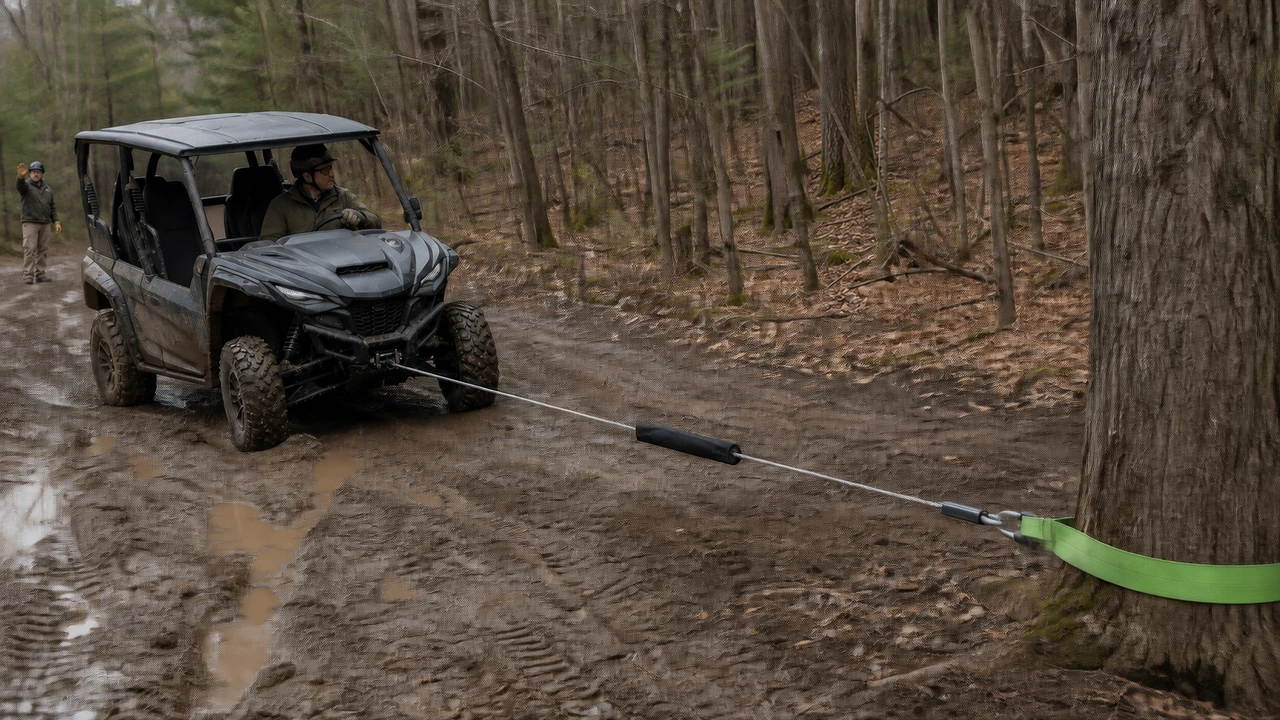
A side-by-side settles into a muddy rut, the front winch line reaches a tree, and the hardware appears to be connected correctly. That is exactly when a hurried crew is tempted to skip the quiet part. The driver sees the anchor. A helper sees the front tire. A bystander moves closer for a better view. Nobody has yet agreed on who may call the pull or how a stop will be acknowledged.
The winch should remain idle until that uncertainty is gone. The safest useful rule is not a magic distance from the rope. It is a shared picture of the complete recovery: both endpoints, every loaded connector, the path the UTV may take, the rope hazard area, the people outside it, and one unmistakable stop signal.
The hazard area is larger than the visible rope
A straight rope can make the danger look narrow. It is not. The current Polaris Winch User Guide describes the rope hazard area as the area within the length of the rope, because a failure can send a connection or section of rope in an unexpected direction. That makes “a few steps to the side” an unreliable plan. The hazard also includes the anchor and the vehicle, where hooks, connectors, mounting points and moving tires can change the event.
Before tension, trace the setup from the winch drum to the anchor without touching the line. Is the pull close to the vehicle centerline? Is the hook latch closed? Is a rated, non-elastic tree-saver or other appropriate anchor connection being used? Is the rope clear of rocks, sharp edges and tires? Is a proper damper placed as directed by the winch maker? A damper may reduce energy if a line fails; it does not make the hazard area a place to stand.
This is also the moment to reject the wrong rigging. A stretching recovery strap or elastic line can store energy and is not a substitute for the rated, non-stretch rigging specified for the winch. Never build momentum by driving against slack or “help” the winch with a jerk. A slow-looking shock load is still a shock load.
One operator, one spotter, one agreed stop
The operator owns the winch control. The spotter owns the full-scene view. Everyone else remains outside the recovery area and does not add competing commands. Before the rope is loaded, the operator and spotter should confirm the same simple signal: an open palm means stop. The operator repeats the command, releases the control, and waits. Silence, a lost view, an uncertain gesture or any person entering the area also means stop.
Position matters more than choreography. The spotter should not stand beside the rope, between the UTV and anchor, near the fairlead, or next to a loaded connection. Choose a place outside the rope hazard area with a clear view of the vehicle path and the operator. If no such position exists, do not improvise a blind pull. Re-rig, use a different recovery method, or get qualified help.
The WARN basic winching guide stresses deliberate planning and keeping the vehicle in the operator’s line of sight. That principle is especially useful on a UTV, where trees, bodywork and a low seating position can hide the anchor or a front wheel. A spotter extends awareness; the spotter does not make an invisible setup safe.
What cancels the first pull
The first movement should be small enough to reveal a problem without turning it into a recovery of its own. Stop if the rope begins stacking at one side of the drum, the UTV rotates away from the intended path, the anchor connection shifts, the damper moves out of position, a tire climbs an obstacle unexpectedly, or communication becomes unclear. Do not walk toward a tensioned rope to correct any of those conditions.
Make the system fully slack and disable the control before anyone approaches. Then inspect the line, hook, connectors, anchor, winch mount and vehicle path again. On a long pull, the damper may need to be repositioned as the exposed rope length changes, but only after tension is released. The U.S. Forest Service Driver-Operator Guide likewise directs all people to stand clear before the line is tightened and warns against damaged, angled or poorly protected cable.
A clean recovery is not the one that never pauses. It is the one that pauses before the setup becomes ambiguous. Clear the rope hazard area, agree on one stop signal, take up tension gradually, and treat every change as a reason to reassess. The few seconds spent confirming the scene are part of the pull, not a delay before it.
Field references
Use this field note as a planning aid, not as a replacement for the exact winch and vehicle manuals. Recovery loads, approved rigging, anchor points and control procedures vary by equipment and situation.